
A growing group of entrepreneurs and cultural practitioners is bringing new businesses and ideas to Dapeng Fortress, creating a new community of shop owners who are helping reshape life in the historic district.
Built during the Ming Dynasty (1368-1644) as a coastal defense stronghold, Dapeng Fortress covers nearly 100,000 square meters and is home to a well-preserved cluster of Ming and Qing-era residences. Its historic architecture and vibrant community life have attracted entrepreneurs from diverse backgrounds.

A Hong Kong couple who traveled extensively before settling in Dapeng Fortress now runs a café, serving a menu that draws on flavors from around the world, from pasta and Mexican snacks to Japanese cold noodles and Thai tom yum soup.
Sherry, who spent part of her childhood in Dapeng, returned after graduation and opened a variety store, named after her cat. For her, the shop is intended to offer visitors more than just products — it is a place to slow down and experience the atmosphere of the old town.
Xia Tian, a former cultural and tourism producer who had worked in several major cities and traveled across China, also decided to stay after discovering the historic town. She now runs a guesthouse in a former residence, combining traditional Chinese aesthetics with ethnic-style decorations.
Huang Xianyun, an inheritor of traditional qipao-making techniques, runs a qipao studio where visitors can drink tea, try on traditional garments and learn about the craft.
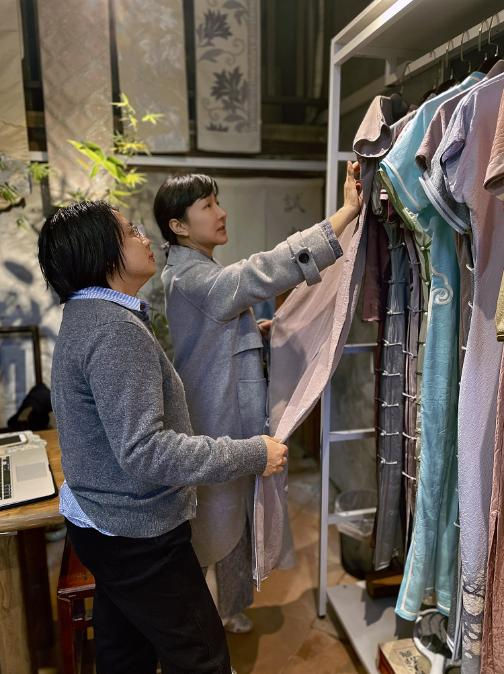
Huang Xianyun introduces qipao to a customer.
Liu Na, who holds an MBA and focuses on heritage preservation, has opened several distinctive cultural businesses and developed creative products while seeking to preserve the original structures of the historic buildings. Her projects include traditional culture-themed spaces featuring modular interiors and Chinese-style courtyards.
The shop owners are also working together to build a stronger community around the historic town. Liu has helped establish a cultural and creative alliance and a designers' club, organizing study programs, talks and hands-on workshops involving intangible cultural heritage practitioners, artisans and artists.
Other businesses, including pottery studios, also offer public workshops in ceramics, Chinese painting and seal carving.
For Sherry, cooperation among shop owners has been an important part of running a business in the old town. Shop owners share their experience, help one another prepare their storefronts and work together to improve the atmosphere of the surrounding streets.
“We are not just supporting our own shops,” Sherry said. “We are also creating the atmosphere of the whole street together.”
Through businesses, cultural activities and everyday interaction with visitors, the new generation of shop owners is experimenting with ways to connect historic preservation with contemporary lifestyles, giving the ancient fortress new possibilities for community life.
Website Identification Code:
4403930001
 Record Number With Public Security Organs:
44031202000003
